Recognizing and Responding to Neonatal Encephalopathy: A Call to Action for Missouri Hospitals
Published Oct 29, 2026
Background on Neonatal Encephalopathy
Neonatal encephalopathy (NE) is a broad term describing brain dysfunction in newborns that results in altered mental status and abnormal neurological findings.1 NE can arise from several causes, including hypoxia-ischemia, metabolic disorders, inflammation, thromboembolic events and genetic conditions.2 Hypoxic-ischemic encephalopathy (HIE), caused by reduced oxygen or blood flow to the brain before, during or shortly after birth, accounts for an estimated 30%-80% of NE cases.
NE occurs in two phases: the initial brain injury caused by oxygen or blood flow deprivation and a secondary injury that develops when blood flow returns, triggering inflammation and cellular damage. Because this secondary injury typically occurs within the first six to 48 hours of life, timely treatment is critical.3 Therapeutic hypothermia (TH), which cools the infant’s body to 33.5°C – 34.5°C for 72 hours, has been shown to reduce death and disability when initiated within six hours of birth in eligible term and near-term infants with moderate-to-severe HIE.4
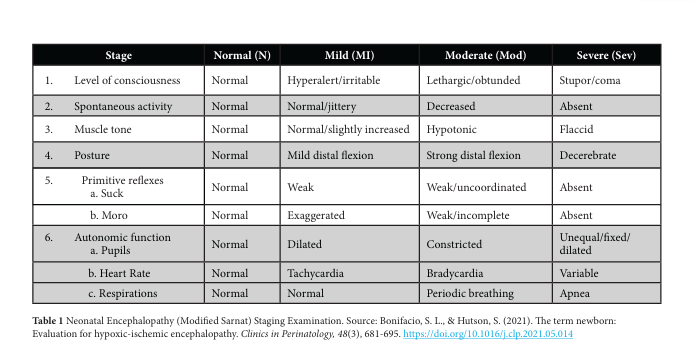
Determining eligibility for TH requires assessment of the infant’s perinatal history, blood gas results and neurological status. The Modified Sarnat Exam is the most commonly used tool for evaluating encephalopathy severity. Infants typically qualify for TH if they have seizures or demonstrate moderate-to-severe abnormalities in at least three of six neurological categories (see Table 1).5Infants with mild findings should undergo repeated neurological assessments during the first six hours of life to identify any progression.
In addition to TH, infants with moderate or severe NE often undergo neuroimaging and specialized monitoring. While imaging can provide clues to the areas of the brain that may have experienced an injury, the extent of the injury may not be known for several months or years. Long-term outcomes vary widely and may include developmental delays, intellectual disabilities, epilepsy, cerebral palsy, organ dysfunction or death.6 However, some infants recover from NE without lasting impairment. Outcomes are strongly influenced by the severity and duration of the initial injury and the timeliness of treatment.
The impact of NE extends beyond the infant. Families often experience significant emotional distress, grief and uncertainty regarding their child’s prognosis. Trauma-informed care, transparent communication, social work support and ongoing developmental follow-up can help families navigate these challenges. Given the substantial lifelong health, social and economic burdens associated with NE, early recognition and prompt treatment remain essential.
Missouri’s Call to Action
The true incidence of neonatal encephalopathy is difficult to measure because the condition can be hard to identify and diagnosis coding is inconsistent. In developed countries, NE is estimated to occur in three to four infants per 1,000 live births, while HIE occurs in one to three infants per 1,000 live births.7 Missouri data suggest an increase in identified NE cases, rising from approximately 57 cases in 2016 (0.07% of births) to an estimated 254 cases in 2025 (0.36% of births), which would align with averages for infants born in developed countries.8
Reducing morbidity and mortality from NE requires consistent screening, early recognition and timely initiation of therapeutic hypothermia for eligible infants. Because TH is only available at select Level III and IV NICUs in Missouri, every birthing facility should maintain a reliable referral and transport process to ensure eligible infants reach a cooling center and begin treatment within the recommended six-hour treatment window.

Transport teams who care for these patients should be trained in neurological assessment, cooling protocols and stabilization of infants with NE. Cooling centers should be equipped to provide comprehensive care, including therapeutic hypothermia, advanced respiratory support, continuous monitoring, laboratory testing, neuroimaging, neurological consultation and support services for NICU families.
MO PQC’s Neonatal Encephalopathy Quality Improvement Initiative
The Missouri Perinatal Quality Collaborative, in partnership with neonatal experts from across the state through its Neonatal Encephalopathy Steering Committee, has developed the Neonatal Encephalopathy quality improvement initiative and its accompanying resource workbook. Designed to support hospitals and health care teams, the workbook includes a patient safety bundle aimed at improving the recognition, evaluation, transport and treatment of infants with NE.
The patient safety bundle is organized around the AIM framework, which emphasizes five key domains: Readiness, Recognition and Prevention, Response, Reporting and Systems Learning, and Respectful, Equitable and Supportive Care. Together, these components help hospitals establish standardized processes that promote timely, evidence-based care for newborns at risk for NE.
More broadly, the NE quality improvement initiative seeks to equip hospitals and health care teams with the knowledge and tools needed to promptly recognize NE and perform the Neonatal Encephalopathy Assessment Tool (NEAT) examination on infants who meet screening criteria. Early identification is critical, as the American Academy of Pediatrics notes, “Any center or practitioner involved in newborn deliveries should have action plans for prompt recognition and initiation of therapeutic hypothermia or transfer of infants with possible HIE to a center providing therapeutic hypothermia.”9
MO PQC strongly encourages Missouri birthing hospitals, NICUs and hospital transport teams to participate in the Neonatal Encephalopathy quality improvement initiative. By joining this effort, health care teams can strengthen their processes for identifying infants with NE, improve access to timely treatment, and support better outcomes for newborns and families across Missouri.
Organizations interested in participating are encouraged to contact Katie Burch, PQC specialist, at [email protected].
- Sandoval Karamian, A. G., Mercimek-Andrews, S., Mohammad, K., Molloy, E. J., Chang, T., Chau, V., Murray, D. M., & Wusthoff, C. J. (2021). Neonatal encephalopathy: Etiologies other than hypoxic-ischemic encephalopathy. Seminars in Fetal and Neonatal Medicine, 26(5). https://doi.org/10.1016/j.siny.2021.101272
- Bandoli, G., Suttner, D., Kiernan, E., Baer, R. J., Jelliffe-Pawlowski, L., & Chambers, C. D. (2021). Risk factors for neonatal encephalopathy in late preterm and term singleton births in a large California birth cohort. Journal of Perinatology, 42(3), 341-347. https://doi.org/10.1038/s41372-021-01242-z
- National Institute of Neurological Disorders and Stroke. (2026). Hypoxic ischemic encephalopathy. https://www.ninds.nih.gov/health-information/disorders/hypoxic-ischemic-encephalopathy
- Wisnowski, J. L., Wu, T. W., Reitman, A. J., McLean, C., Friedlich, P., Vanderbilt, D., Ho, E., Nelson, M. D., Panigrahy, A., & Blüml, S. (2015). The effects of therapeutic hypothermia on cerebral metabolism in neonates with hypoxic-ischemic encephalopathy: An in vivo 1H-MR spectroscopy study. Journal of Cerebral Blood Flow & Metabolism, 36(6), 1075-1086. https://doi.org/10.1177/0271678X15607881
- Bonifacio, S. L., & Hutson, S. (2021). The term newborn: Evaluation for hypoxic-ischemic encephalopathy. Clinics in Perinatology, 48(3), 681-695. https://doi.org/10.1016/j.clp.2021.05.014
- National Institute of Neurological Disorders and Stroke. (2026). Hypoxic ischemic encephalopathy. https://www.ninds.nih.gov/health-information/disorders/hypoxic-ischemic-encephalopathy
- Bandoli, G. et al. (2021). Risk factors for neonatal encephalopathy in late preterm and term singleton births in a large California birth cohort. Journal of Perinatology, 42(3), 341-347. https://doi.org/10.1038/s41372-021-01242-z; Bonifacio, S. L., & Hutson, S. (2021). The term newborn: Evaluation for hypoxic-ischemic encephalopathy. Clinics in Perinatology, 48(3), 681-695. https://doi.org/10.1016/j.clp.2021.05.014
- Bandoli, G., et al. (2021). Risk factors for neonatal encephalopathy in late preterm and term singleton births in a large California birth cohort. Journal of Perinatology, 42(3), 341-347. https://doi.org/10.1038/s41372-021-01242-z
- Zanelli, S. A., Wusthoff, C. J., Lucke, A. M. Kaufman, D. A., Committee on Fetus and Newborn, & Section on Neurology. (2026). Therapeutic hypothermia for neonatal hypoxic-ischemic encephalopathy: Clinical report. American Academy of Pediatrics, 157(2). https://doi.org/10.1542/peds.2025-073627