
Surviving the Unthinkable: My Journey With Amniotic Fluid Embolism
Published Mar 26, 2026
 On Feb. 1, 2020, my life changed forever.
My name is Courtney Johnson. I am an Amniotic Fluid Embolism survivor, maternal health advocate and Missouri state liaison for the AFE Foundation. What began as a routine delivery of my second full-term pregnancy became a fight for my life — and ultimately, a calling to ensure other families have access to education, support and hope.
This is my story — and why awareness matters.
What Is Amniotic Fluid Embolism?
AFE is a sudden, rare and life-threatening childbirth complication that can affect both mother and baby. It is believed to be an allergic-like reaction that occurs when amniotic fluid enters the mother’s bloodstream.
It’s important to understand that amniotic fluid entering the bloodstream is a normal part of labor and delivery. However, in rare cases, the body reacts catastrophically.
AFE most commonly occurs:
- during labor
- immediately after delivery
- during a C-section
- occasionally during procedures such as amniocentesis or dilation and evacuation
An AFE event often happens without warning. It can escalate within minutes.
The Day Everything Changed
My AFE occurred immediately following the delivery of my son.
During the later part of my labor, my blood pressure became erratic. Shortly after he was born, I began experiencing shortness of breath, loss of vision and an overwhelming sense of impending doom. Within moments, I lost consciousness and went into cardiac arrest. A code blue was called.
I was resuscitated — but that was only the beginning.
My body entered the second phase of AFE: disseminated intravascular coagulation, a severe condition that causes uncontrolled bleeding. I was rushed to the intensive care unit, where I crashed two more times. In total, I required more than 65 units of blood products — exhausting the hospital’s entire blood supply for my blood type.
Once stabilized, doctors determined that a uterine artery embolization was the safest next step. After surgery, I spent two days in the ICU, two days in labor and delivery, and was ultimately discharged nine days after giving birth.
Nine days that changed the course of my life.
The Hidden Aftermath: Birth Trauma and Mental Health
Surviving AFE is only part of the journey.
The emotional and psychological impact can be profound — for survivors and for families who lose a loved one.
Missouri Baptist Medical Center ensured I received mental health resources before discharge. Staff reviewed the information with both me and my spouse. Three months later, I experienced my first post-traumatic stress disorder episode. Because of the resources I had been given, I knew where to turn.
I was later diagnosed with:
- PTSD
- postpartum anxiety
- post-intensive care syndrome
Mental health support should not be optional for families affected by AFE. Every hospital should provide:
- a clear packet of mental health provider resources
- information about survivor and bereavement support
- connections to the AFE Foundation
- resources not just for families, but also for health care providers impacted by these events
Because while AFE is rare — its trauma is not.
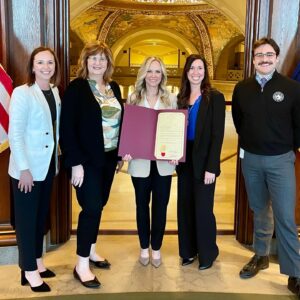 Turning Survival Into Advocacy
After surviving AFE, I knew I couldn’t stay silent.
Today, I serve as:
- the Missouri state liaison for the AFE Foundation
- a member of the Missouri Maternal-Child Learning and Action Network
I have spent four consecutive years advocating for Missouri governors to recognize March 27 as Amniotic Fluid Embolism Awareness Day. I’ve spoken publicly through organizations such as:
- March of Dimes
- AWHONN St. Louis Missouri Chapter
- MoMMA’s Voices
I also contributed my lived experience to help develop the Perinatal Mental Health Conditions Patient Safety Bundle with the Alliance for Innovation on Maternal Health, and I have shared my story in medical simulations and on the Birth Trauma Stories Podcast to help health care teams better prepare for emergencies like mine.
Awareness saves lives. Education changes outcomes.
March 27: AFE Awareness Day
March 27 is more than a date — it is a movement.
AFE Awareness Day is a time to:
- unite as a community
- honor survivors and remember mothers lost
- promote education and research
- advocate for legislation that improves maternal outcomes
Alongside fellow survivors Heather Ulm and Emilee Lenz, I am committed to reducing maternal mortality in Missouri. We work with state stakeholders to promote maternal health education legislation and ensure families across the “Show Me State” have access to lifesaving knowledge.
How You Can Help
Knowledge is power.
Here’s how individuals and medical providers can take action.
For Individuals and Families
- Learn about AFE and share credible resources.
- Advocate for state recognition of AFE Awareness Day.
- Create safe spaces for pregnant mothers to ask questions and voice concerns.
- Direct families affected by AFE to the AFE Foundation for support.
- Resources for patients and families
For Medical Providers
- Complete the foundation’s free CNE-accredited training courses.
- Incorporate AFE emergency simulations into labor and delivery training.
- Ensure discharge packets include mental health and survivor resources.
- Commit to continued research and specimen collection to better understand risk factors.
- Review AFE research and education resources from the AFE Foundation.
The AFE Foundation’s training programs have been recognized as essential by leading medical institutions. Education is one of the most powerful tools we have to reduce deaths related to AFE.
From Survival to Purpose
I survived something that many do not.
My story is not just about trauma — it is about resilience, advocacy and the power of preparation. If greater awareness, stronger education and improved mental health support can spare even one family from the devastation of AFE, then sharing my story is worth it.
March 27. Remember the date. Share the knowledge. Save a life.
To learn more or access support resources, visit the AFE Foundation website.
Because no mother should face this alone.